
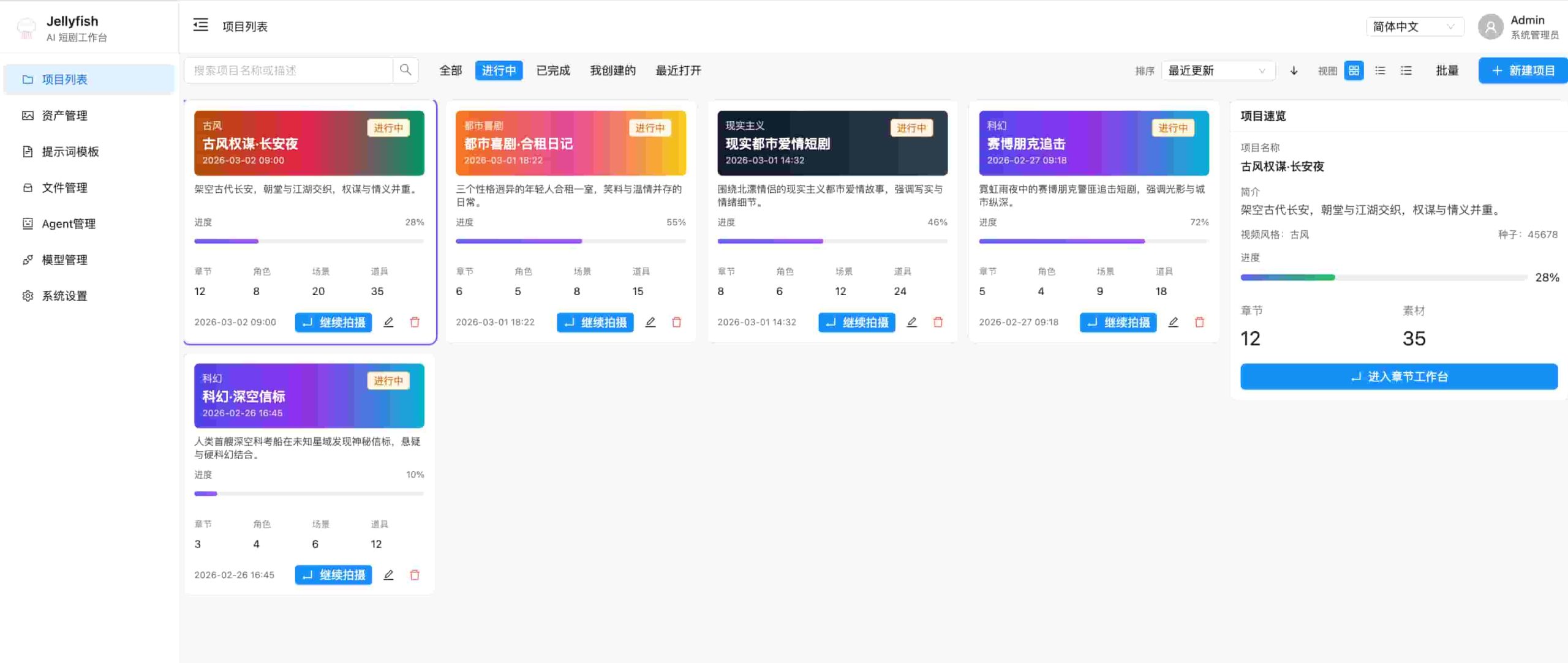
If AI video tools in the past solved the problem of "generating a video", then Jellyfish wanted to solve the problem of "producing a short drama."
When I visited GitHub recently, I discovered a very interesting open source project--Jellyfish。
GitHub address:
Forget-C/Jellyfish
In just a few months, the project has gained thousands of Stars and has become one of the most watched open source projects in the field of AI video creation. Its biggest feature is not its model ability, butRedefined the production process of AI short dramas。(T.co)
Today, let's talk about what problems this project solves and why it deserves the attention of all AI creators.
There are many AI video tools, but why can't everyone make short dramas well?
There are many AI tools on the market today.
- ChatGPT writes the script
- Photos of Midjourney, Flux
- Kling, Runway, Veo generate videos
- ElevenLabs voice over
- Cut and finish editing
It seems that the tools are complete.
But anyone who has actually done AI short dramas will find one reality:
Tools are getting stronger and processes are becoming more and more chaotic.
For example:
- The characters created today will change their faces tomorrow;
- Three costumes were changed for the same character;
- A scene is repeated dozens of times;
- Copy and paste Tips everywhere;
- Pictures, videos, and character materials are scattered in dozens of folders.
What really limits the development of AI short dramas has never been models.
butproduction process。
Jellyfish is a complete workflow designed around this issue.
Jellyfish is not an AI video tool
The official definition of it is very clear:
An end-to-end production workspace for AI-generated short dramas
The translation is:
A one-stop production workbench for AI short drama creation.
When many people see a project for the first time, they will mistake it for another one:
Enter a Prompt → Output video
Not at all.
It's more like:
AI short drama version is a combination of Notion + Jira + Midjourney + Runway.
It focuses on the entire production chain rather than a single generation.
It breaks down the production of short dramas into a complete assembly line
Jellyfish standardizes the entire creative process.
The entire process is roughly as follows:
剧本
↓

AI 理解剧本

↓

自动拆分分镜

↓

识别人物
识别场景
识别道具
识别服装

↓

建立统一资产

↓

确认每个镜头

↓

AI 图片生成

↓

AI 视频生成

↓

统一管理任务

↓

导出成片
The official summarizes this process as:
Script → Storyboard → Asset → Generation → Export。
This is no longer a "tool", but a production line.
Biggest highlight: Role consistency management
If you have ever done an AI video, you must know the biggest pain points:
Role consistency.
For example:
In the first episode, the female lead was like this.
The second episode changed a face.
In the third episode, the age has changed.
Episode 4: The hairstyle has changed.
The clothes in the fifth episode also changed.
In the end, the audience couldn't recognize it.
Jellyfish has designed an asset management system specifically.
It will manage all elements in a unified manner:
- characters
- scene
- props
- clothing
- actor
Each shot references these assets rather than recreating them.
This avoids:
Every shot re-creates the world.
Instead:
Continue to create in the same world. (T.co)
AI automatically understands scripts
This is also very interesting.
Traditional workflow:
The writer writes the script.
The director split the shots himself.
Now it becomes:
Enter the script.
AI automatic analysis:
- characters
- scene
- dialogue
- props
- emotions
- lens
You can even do:
- Screenplay optimization
- Streamlining content
- consistency check
Finally, a structured mirror is generated.
That is to say,
AI is not just about generating content.
Started participating in directing work.
Each lens has its own life cycle
Many AI video tools only include:
Click Generate.
End.
Jellyfish designed the lens as a true working unit.
Every Shot experiences:
待分析

↓

待确认

↓

素材准备

↓

Ready

↓

开始生成

↓

完成
Each step can be modified.
Each step can be regenerated.
Every step can be traced.
This is actually moving the Workflow idea from Internet products into AI creation. (T.co)
Unified scheduling of all AI tasks
Another design worthy of praise:
It does not write AI calls dead.
Instead, a unified mission center was designed.
Regardless of:
- LLM
- picture generation
- video generation
All enter the asynchronous task system.
You can:
- looking at the progress
- Time consuming viewing
- cancel the task
- retry task
- Return to corresponding item
This means connecting to any model in the future:
- Flux
- SDXL
- Kling
- Veo
- Runway
- ComfyUI
will not affect the overall process.
Models are just plug-ins.
Process is the core.
More like an AI creation operating system
After reading the entire project, my biggest feeling is:
Jellyfish is not doing AI.
It is doing:
AI creates operating systems.
In the past few years, most projects have focused on:
Models are getting stronger and stronger.
Prompt is becoming more and more complex.
But after really entering commercial production, everyone found that:
It is not the model that determines efficiency.
It's the process.
What's really important in the future is:
- workflow
- data management
- material management
- consistency
- Automatic collaboration
Instead, models are just bottom-level capabilities.
Who is suitable for using Jellyfish?
Typical usage scenarios given by the official include:
- AI micro-drama creator
- AI Video Studio
- Independent content creators
- Education Training Video Production Team
- Brand Marketing and E-Commerce Content Team
If your goal is to mass-produce content rather than occasionally generate a video or two, such workflow tools will be more valuable than simply generating models.
written in the end
In the past year, we have witnessed rapid progress in AI video models.
In the next stage, the focus of the competition may no longer be who can generate faster, but who can build it.A more stable, efficient and reusable production system。
Jellyfish is a representative of this idea:
It does not seek to become the "strongest model", but to become a unified platform that connects scripts, splits, assets, generation, tasks and exports, upgrading AI video creation from "generation after generation" to "sustainable production." (T.co)
If you are paying attention to AI skits, AI videos or content industrialization, this project deserves in-depth research.
Project address: