
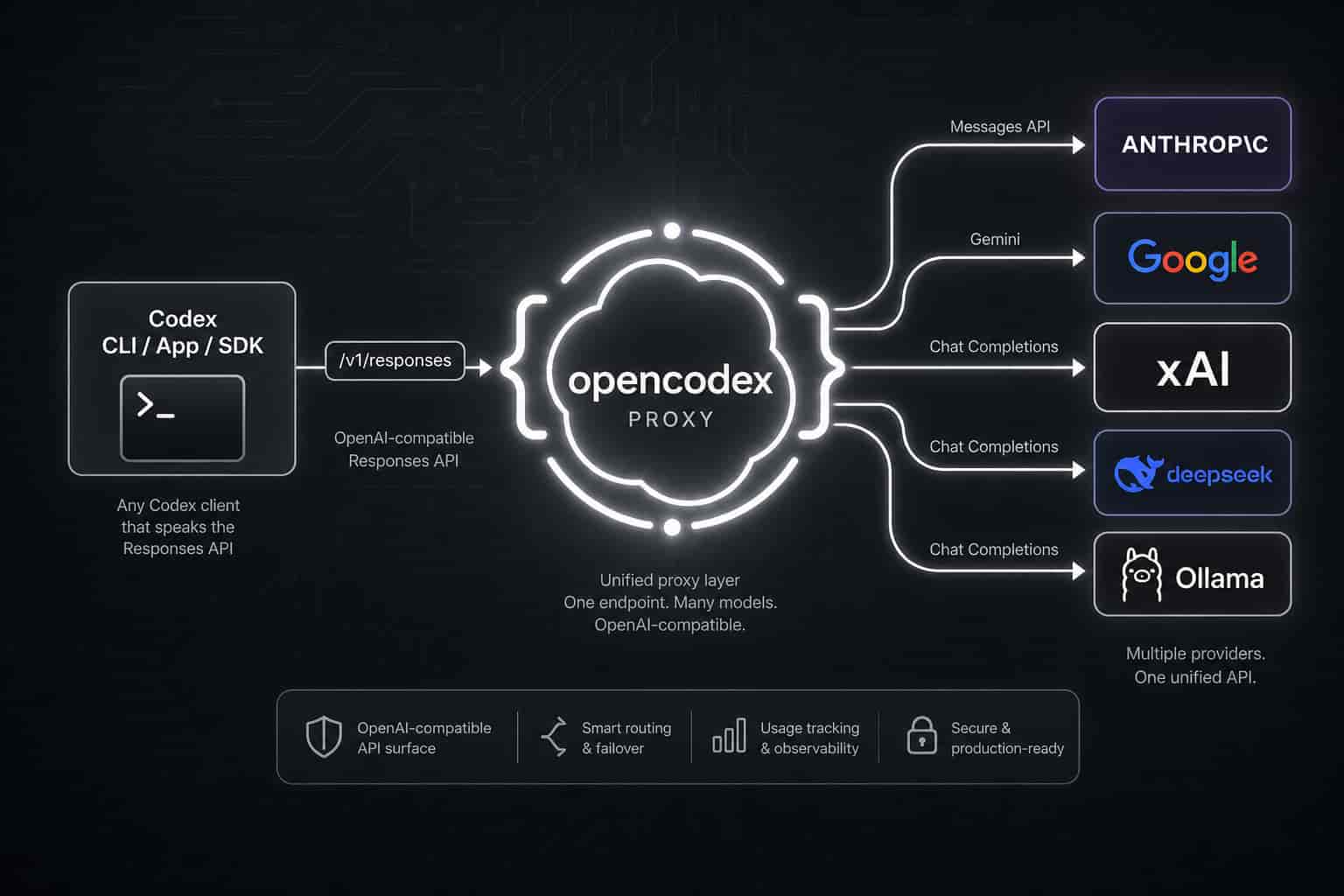
With the rapid development of AI programming tools, developers are facing a new choice problem:
Which model should I use?
Claude is good at code understanding and has strong GPT comprehensive capabilities, Gemini has the advantage of long context, DeepSeek has high cost performance, and local models pay more attention to privacy and controllability.
But the reality is that most AI programming tools are often tied to a single model ecosystem. Developers who want to switch models need to change tools, modify configurations, and even readjust new interactions.
Recently, a project called OpenCodex provides a new solution.
Project address: GitHub / lidge-jun/opencodex
A bridge between AI programming tools and multiple models
OpenCodex is essentially a native-running proxy for the AI model.
It is located between development tools and big model services, converting requests from tools such as Codex and Claude Code and then forwarding them to different big model platforms.
Traditional model:
Codex → OpenAI 模型
After using OpenCodex:
Codex
  ↓
OpenCodex
  ↓
Claude / Gemini / GPT / DeepSeek / Ollama 等模型
Developers can freely switch between different models without modifying the original workflow.
Simply put, the problems it hopes to solve are:
Let AI programming tools no longer bind to a certain model, but become the gateway to the entire model ecosystem.
Support multiple model suppliers
The current large model market has entered a stage of multi-model competition, and different models have different advantages.
For example:
- Claude: Outstanding ability in code understanding and complex project analysis
- GPT: Strong comprehensive reasoning ability
- Gemini: Long context, excellent multimodal capabilities
- DeepSeek: Significant cost advantage
- Olama: Suitable for local deployment and privacy scenarios
OpenCodex unifies APIs from different vendors through a Provider adaptation layer.
Developers can choose models based on tasks:
Use Claude when writing architectural code;
Use GPT when solving complex algorithm problems;
Use DeepSeek when quickly generating scripts;
Use local models when working with internal code within an enterprise.
The AI programming process has thus changed from a "fixed model" to a "model combination".
Technology core: Unified API and request conversion
The biggest obstacle between different AI platforms is that interface standards are inconsistent.
Services such as OpenAI, Anthropic, and Google Gemini have different API formats, parameter definitions, and return structures.
OpenCodex is done through the proxy layer:
- request parsing
- format conversion
- model routing
- responds to the transduced
Developers face a unified entrance, while different models can be connected behind it.
This design is similar to a unified gateway in database ORM or cloud computing:
Top-level applications do not need to care about bottom-level differences.
Practical value brought by OpenCodex
For individual developers, it can reduce AI programming costs.
In the past, a single high-level model might have been used for a long time, but now different models can be selected based on the complexity of the task:
Simple code generation uses a low-cost model;
Call strong models for key design issues;
Sensitive projects run local models.
For enterprises, OpenCodex also provides a new way to access AI.
Enterprises can manage through a unified agent layer:
- Public cloud model
- Private model
- Local deployment model
Connect AI programming tools with enterprise model systems.
AI programming tools are entering the "multi-model era"
In the past few years, developers have focused on:
"Which AI programming tool is the best?"
Future problems may become:
"How to combine different AI models and make them work together?"
An ideal development environment might be:
Claude is responsible for code review;
GPT is responsible for complex reasoning;
DeepSeek is responsible for daily development;
The local model is responsible for privacy tasks.
OpenCodex is exploring this direction:
Decouple AI tools from models and give developers the choice of models.
With the development of AI agents and intelligent development environments, model agent layers similar to OpenCodex may become important infrastructure connecting various AI capabilities.
Project address:
GitHub:lidge-jun/opencodex
If you are using AI programming tools, OpenCodex is worth paying attention to. It represents a trend:
Future developers may not necessarily choose only one AI, but may have a complete AI development team.